
You’re not a graphic designer.
I know this because, if you were, you wouldn’t be looking up Canva reviews in your search for an affordable, easy-to-use online graphic design tool.
If you do any type of work online, like web design or blogging, then graphic design is going to be a central component of your work. (especially if you’re a blogger)
It’s just a natural fit.
When I first started blogging to market my web design business, I was conducting the exact same search. I needed a graphic design tool that was free, simple, and so easy to use. I didn’t have time to learn graphic design skills from scratch.
And that’s when I came across Canva.
Why do you need a graphic design tool?
Because, in short, the internet runs on imagery. More than ever before.
People don’t have time to read your 3,000 word blog post. They will, however, skim through your post and pause at all of the unique and custom imagery you’ve created. That is, if it’s any good.
In this day and age, it’s crucial to get your brand’s message across through images and video.
For that reason, you’re going to need a good graphic design tool to design your own custom images. And, if you’re a complete newb like I was, you want that graphic design tool to be super easy to use.
So let’s dive in to this full review of Canva and see if it makes sense for you, shall we?
Features
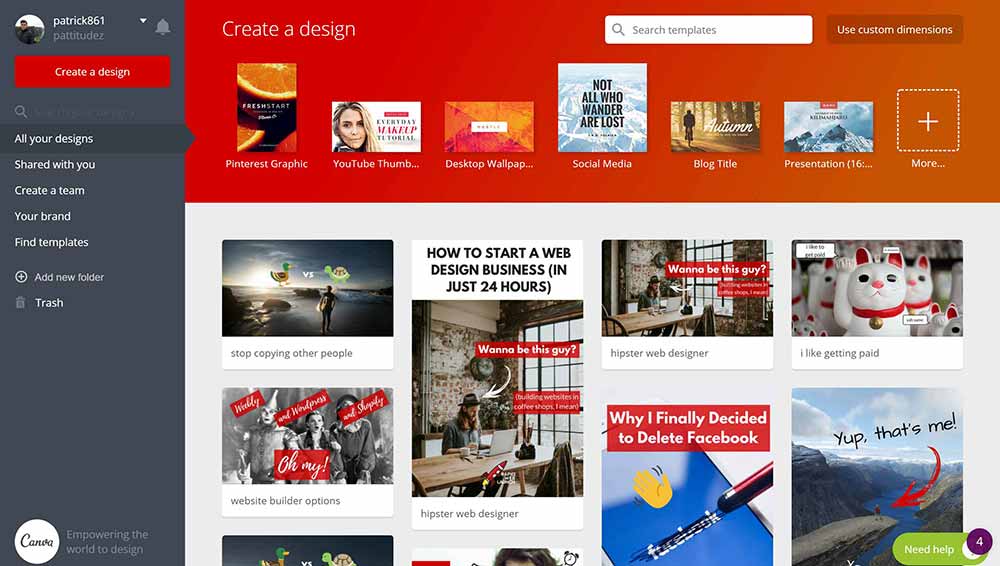
Canva is loaded with awesome features. The basics are all covered, as well as some more advanced stuff.
- Adding custom text and fonts to images
- Image editing (tints, transparency, flipping, cropping, straightening, framing and more)
- Free and premium stock photos
- Free and premium illustrations and icons
- Ability to upload your own images and icons
- Automatic image resizing
- and much more…
But by far the coolest thing about Canva is the sheer number of custom templates they have on display.
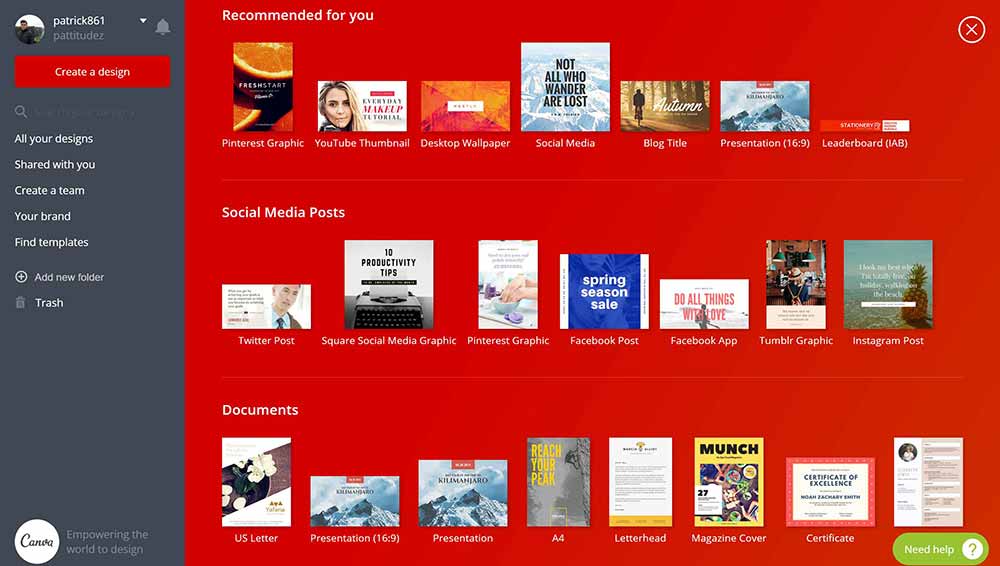
Blogging, ebooks, social media, YouTube, marketing documents, graphs, desktop wallpapers… it’s all here.
Start from scratch, or choose a beautiful template to help give you some inspiration. Here are some of the templates you have to choose from:
- Social Media
- Tumblr
- Social media profile headers
- Social media ads
- Blogging and eBooks
- Book cover
- Desktop wallpaper
- Web banner
- Photo collage
- Blog banner
- Infographic
- Marketing Materials
- Poster
- Menu
- Flyer
- Logo
- Brochure
- Gift certificate
- Business card
- Events
- Postcard
- Invitation
- Card
- Program
- Announcement
- And more…
And, of course, Canva is always growing their template database as the internet evolves. (do I see some Virtual Reality templates in the near future?)
Ease of Use
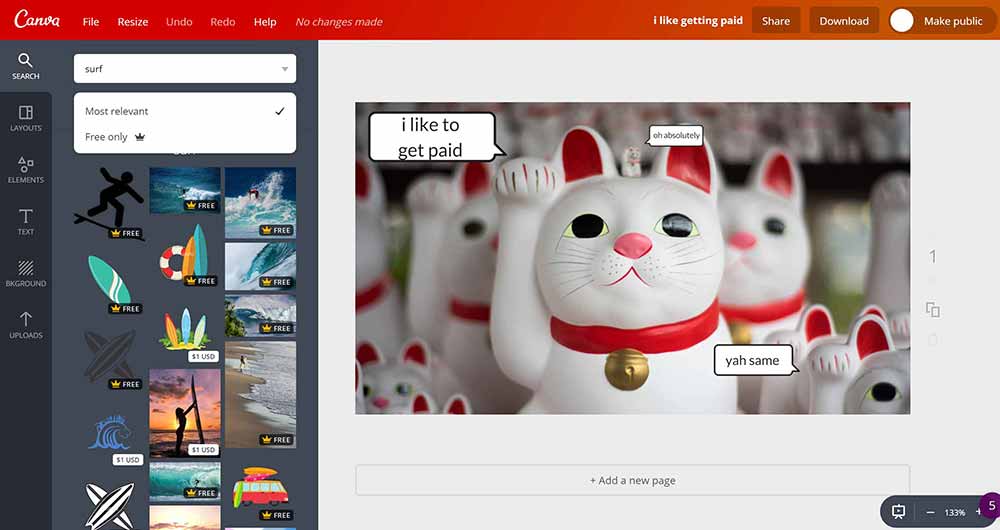
But Canva’s real strength is how easy it is to use.
It utilizes a drag-and-drop interface, much in the same way that Weebly does.
No coding. No pencils, paint, or brushes.
Canva also uses a unique wireframe system that automatically “snaps” your images, icons and text into the proper place. This makes it absurdly easy to align your graphics any way you like.
Your clients will think you’re a professional graphic designer.
It’s honestly hard to convey just how simple it is. That’s why I encourage you to sign up for the free account and try it yourself!
Pricing
When I first signed up with Canva, I went with the free version.
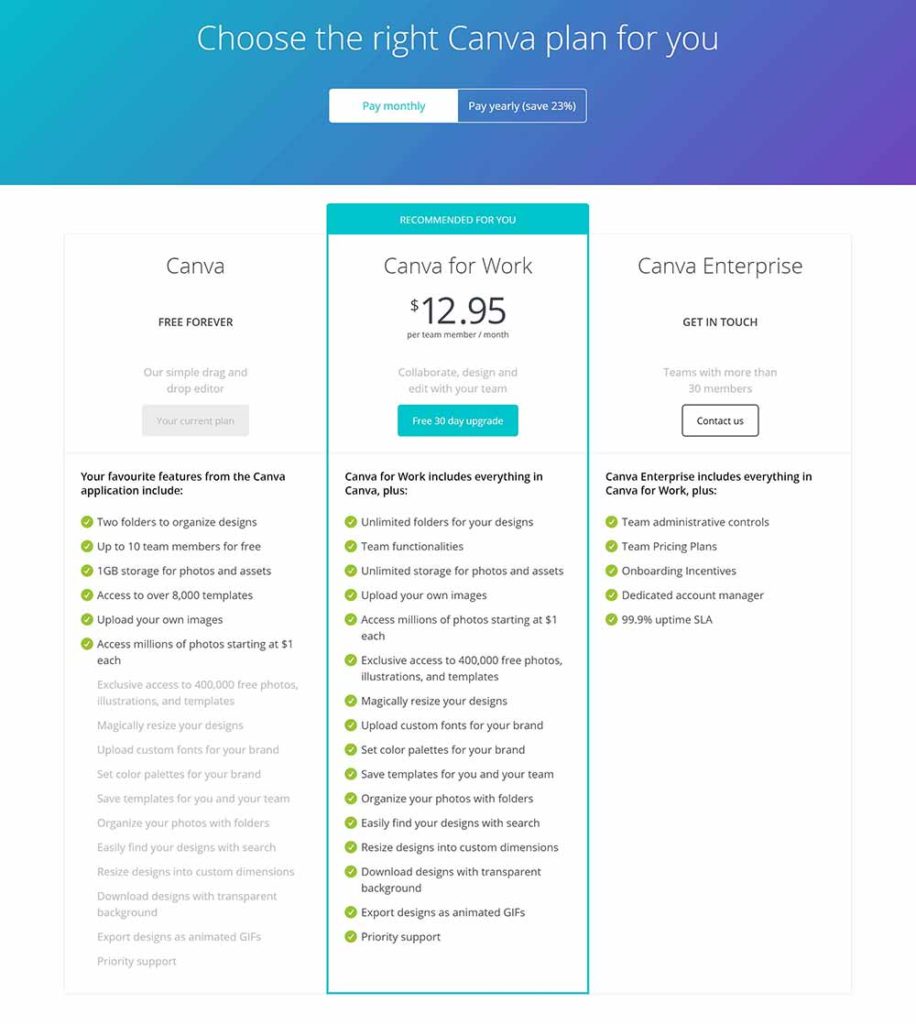
After using Canva for a few months, it became clear to me that this was a product worth paying for. In fact, at $13/month, I think it’s a straight up bargain.
It is a small investment to make in what is such a crucial part of building an effective brand. You can see above the extensive list of features that are only available with the premium version.
Another option is to go with the free account, and just pay for premium images as you need them. They go for about $1 each.
So, if you’re someone who only needs to create a handful of images a month, this could be a better option for you.
They do also offer an Enterprise version of their product, but it seems to be limited to companies larger than 30 employees. (maybe one day Patrick, maybe one day…)
Customer Support
I’ve been using Canva for about 2-3 years and I’ve never once had to contact customer support for help. That’s how easy it is to use. (I know, I sound like a broken record)
But, in case you find yourself in need of some help, they have built a massive library of content to hold your hand along the way.
Blog posts, videos, tutorials and even full online courses are all at your disposal. Completely free.
That said, if you find all of that overwhelming, and need to talk to a human being, it is very difficult to find some contact info. Unfortunately, this is a very common practice with online businesses these days. Who’s got time to talk?
But, honestly, you’re not going to need to talk to anyone often. (if at all)
Conclusion
If you’re in need of a free graphic design tool that is easy to use and won’t take you months to master, then I can’t recommend Canva enough.
I know what you might be thinking. The answer is no, I’m not getting paid for this review. Though I probably should be, right Canva? ?
I just love their product so much that I believe more online business owners and bloggers should know about it.
And you know what? It’s completely free. So why not try it out for yourself and let me know what you think?
 Posted: 04/20/20 | April 20th, 2020
From lively
Posted: 04/20/20 | April 20th, 2020
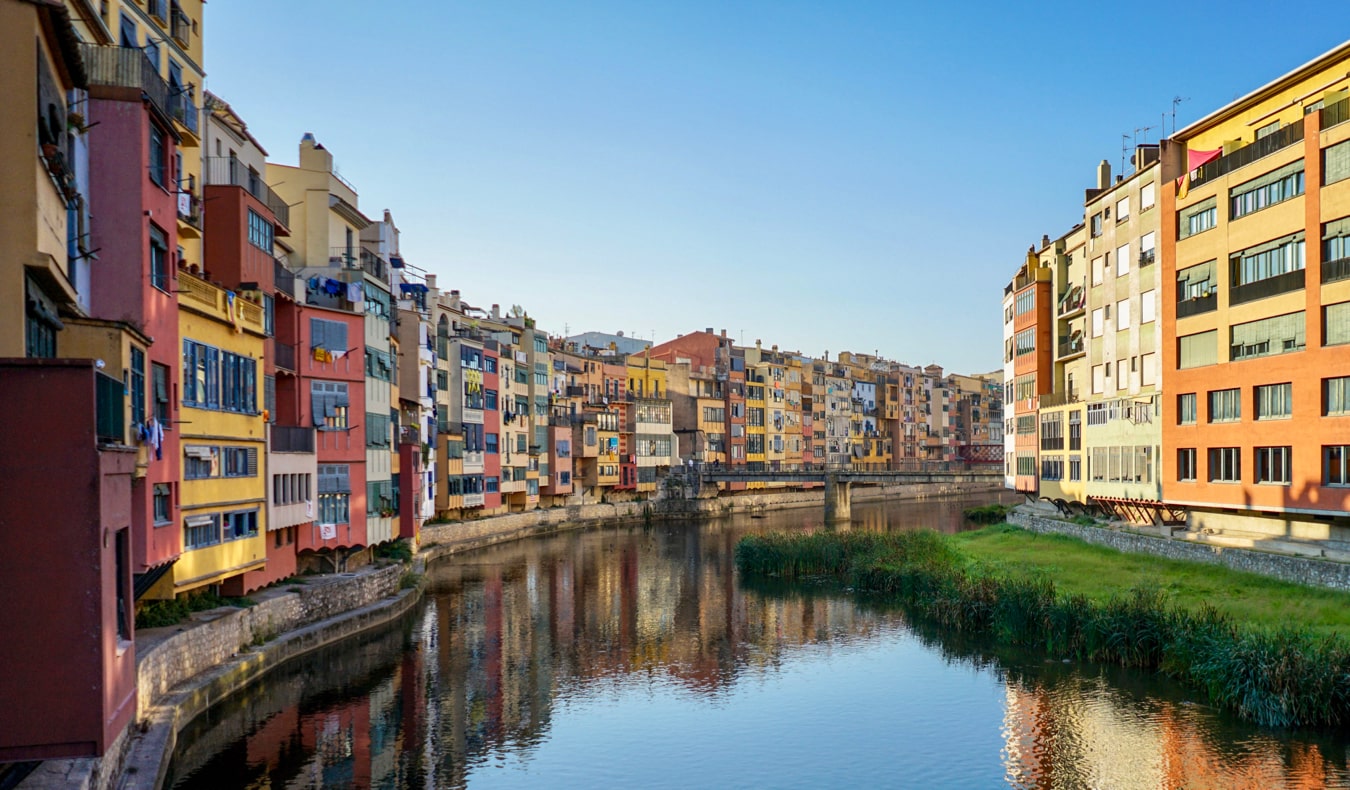
From lively 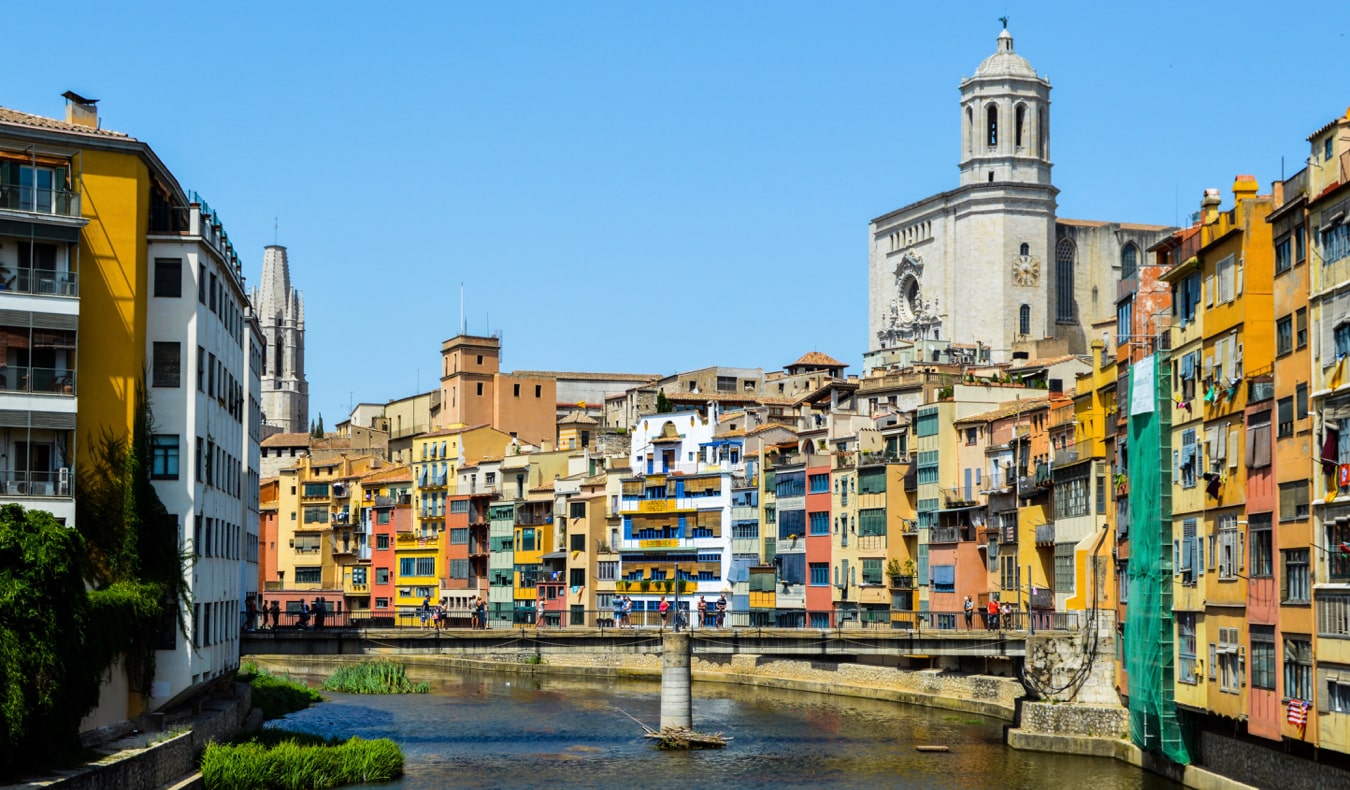 Girona’s Old Quarter (Barri Vell) sits beside the River Onyar. This neighborhood is home to some of Girona’s most popular and well-preserved historical sites. Filled with medieval architecture, colorful old homes, and picturesque bridges but without the crowds of Barcelona, this is my favorite area to wander around.
You can explore it yourself and enjoy getting lost, but before also check out the tours
Girona’s Old Quarter (Barri Vell) sits beside the River Onyar. This neighborhood is home to some of Girona’s most popular and well-preserved historical sites. Filled with medieval architecture, colorful old homes, and picturesque bridges but without the crowds of Barcelona, this is my favorite area to wander around.
You can explore it yourself and enjoy getting lost, but before also check out the tours  Built between the 11th and 13th centuries, the Cathedral of Saint Mary of Girona towers over the city. It’s the second widest church in the world, almost 23m (75 feet) across — only St. Peter’s Basilica in the Vatican is wider. (It was also featured in Game of Thrones!)
The interior isn’t particularly ornate and has a bit of an austere feel to it, but it’s peaceful, and there’s a lot of information and a good audio guide available.
Plaça de la Catedral, +34 972 42 71 89, catedraldegirona.cat. Open 10am–6:30pm, April–June; 10am–7:30pm, July–August; 10am–6:30pm, September–October; 10am–5:30pm, November–March. Admission is 7 EUR ($7.70 USD). Dress respectfully, as it is a place of worship.
Built between the 11th and 13th centuries, the Cathedral of Saint Mary of Girona towers over the city. It’s the second widest church in the world, almost 23m (75 feet) across — only St. Peter’s Basilica in the Vatican is wider. (It was also featured in Game of Thrones!)
The interior isn’t particularly ornate and has a bit of an austere feel to it, but it’s peaceful, and there’s a lot of information and a good audio guide available.
Plaça de la Catedral, +34 972 42 71 89, catedraldegirona.cat. Open 10am–6:30pm, April–June; 10am–7:30pm, July–August; 10am–6:30pm, September–October; 10am–5:30pm, November–March. Admission is 7 EUR ($7.70 USD). Dress respectfully, as it is a place of worship.
 These preserved public baths were built in 1194. Their Romanesque style was inspired by similar Roman and Arab baths and was built in response to ancient Girona’s growing population and the need to improve hygiene.
While you can’t actually use the baths, you can take a self-guided tour to see what bathing was like in the Middle Ages. The building is covered by a large vaulted ceiling and includes a cold-water bath, a hot-water bath, and changing rooms.
Carrer del Rei Ferran el Catòlic, +34 972 21 32 62, banysarabs.org. Open Monday–Saturday 10am–6pm and Sundays 10am–2pm. Admission is 2 EUR ($2.20 USD).
These preserved public baths were built in 1194. Their Romanesque style was inspired by similar Roman and Arab baths and was built in response to ancient Girona’s growing population and the need to improve hygiene.
While you can’t actually use the baths, you can take a self-guided tour to see what bathing was like in the Middle Ages. The building is covered by a large vaulted ceiling and includes a cold-water bath, a hot-water bath, and changing rooms.
Carrer del Rei Ferran el Catòlic, +34 972 21 32 62, banysarabs.org. Open Monday–Saturday 10am–6pm and Sundays 10am–2pm. Admission is 2 EUR ($2.20 USD).
 The Palanques Vermelles Bridge, also known as the Eiffel Bridge, was built in 1827 by Gustave Eiffel just before the construction of his most famous work, the Eiffel Tower. Located over the Onyar River, it’s a great place to get some pics of the Old Town’s colorful buildings. I try to cross this bridge often, simply because the view is so nice!
 For a small city, Girona is home to quite a few museums and art galleries. Here some I think you shouldn’t miss:
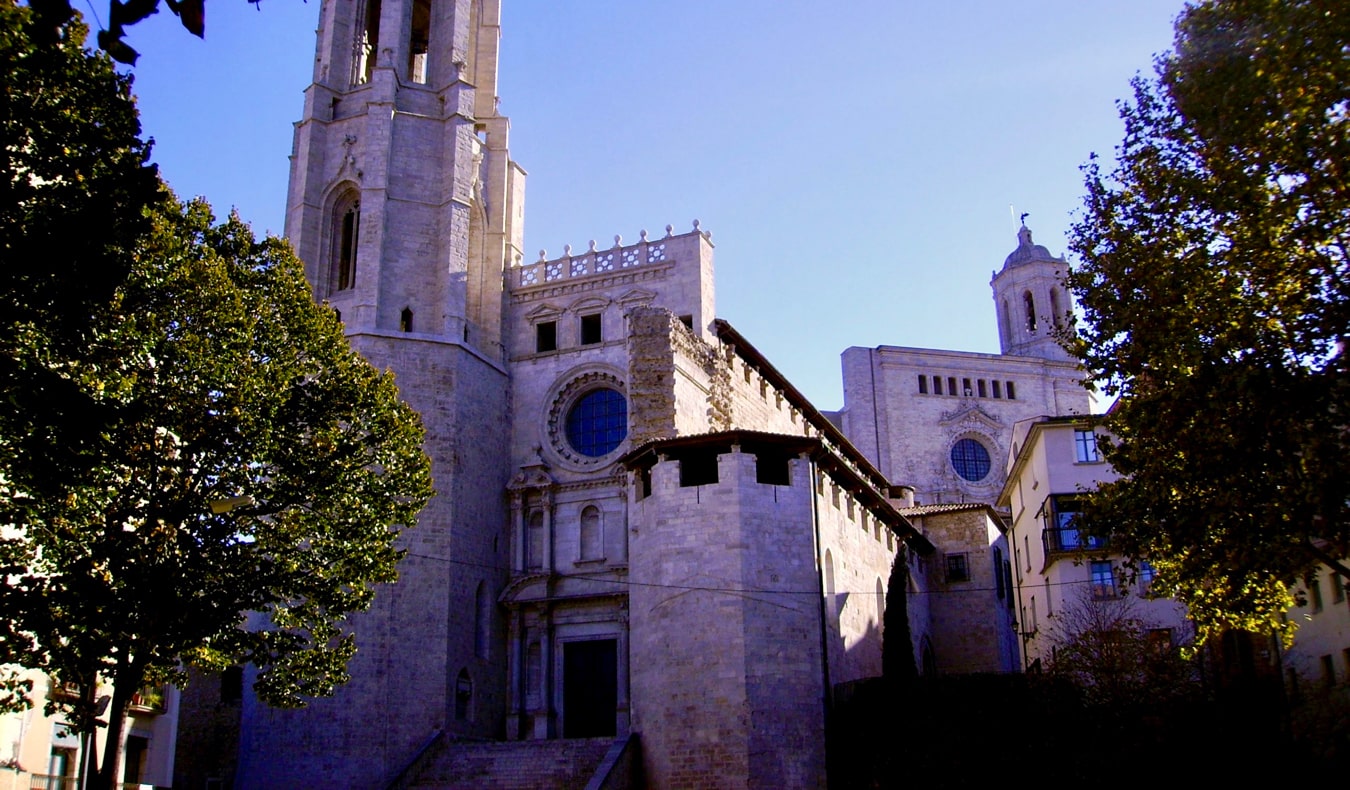 This historic Gothic cathedral is eye-catching and hard to miss. It almost looks like a castle. Its bell tower is visible from most spots around Girona, so it’s never far from view.
It was the first cathedral in Girona and remained the only one until the 10th century. Beyond the impressive architecture, the cathedral is home to historic works of art, including a 14th-century sculpture of Christ, as well as Christian and non-Christian sarcophagi that date back to the fourth century.
Plaça de la Catedral, +34 972 427 189, catedraldegirona.org. Open Monday–Saturday 10am–5:30pm, Sunday and holidays 1pm–5:30pm. Admission is 7 EUR ($7.70 USD).
This historic Gothic cathedral is eye-catching and hard to miss. It almost looks like a castle. Its bell tower is visible from most spots around Girona, so it’s never far from view.
It was the first cathedral in Girona and remained the only one until the 10th century. Beyond the impressive architecture, the cathedral is home to historic works of art, including a 14th-century sculpture of Christ, as well as Christian and non-Christian sarcophagi that date back to the fourth century.
Plaça de la Catedral, +34 972 427 189, catedraldegirona.org. Open Monday–Saturday 10am–5:30pm, Sunday and holidays 1pm–5:30pm. Admission is 7 EUR ($7.70 USD).
 Founded in the 11th century, this monastery located on the outskirts of town was created with the intention of establishing a nunnery in the region. While the abbey is no longer in use, you can still visit the church and the cloister. Inside, you’ll find Saint Daniel’s sepulcher, rumored to house the remains of the saint himself. The architecture is a mix of Romanesque and Gothic, with additions from the 12th and 15th centuries.
The monastery is surrounded by the Valley of Sant Daniel, a lush green space with lots of shade and picturesque natural springs.
Founded in the 11th century, this monastery located on the outskirts of town was created with the intention of establishing a nunnery in the region. While the abbey is no longer in use, you can still visit the church and the cloister. Inside, you’ll find Saint Daniel’s sepulcher, rumored to house the remains of the saint himself. The architecture is a mix of Romanesque and Gothic, with additions from the 12th and 15th centuries.
The monastery is surrounded by the Valley of Sant Daniel, a lush green space with lots of shade and picturesque natural springs.
 Dating to Girona’s medieval past, these ancient walls were partially destroyed in the 1800s to make way for city expansion. Fortunately, many of the missing pieces have been recovered or reconstructed in recent times. Taking a stroll atop them offers an unbeatable view of both the city and the countryside’s rolling hills. Plus, they’re free!
 Lined by gorgeous neoclassical, baroque, and Gothic buildings, this is the main pedestrian street in town. The street dates back to 1885 and is full of shops, cafés, and restaurants. There’s also a flower market on Saturdays.
 This is one of the best gelaterias I’ve ever been to! Owned by world-class chef Jordi Roca, it’s a great spot to (over)indulge in delicious ice cream and gelato topped with berries, cotton candy, fruits, whipped cream, chocolate sauce, fudge, and so much more. I go there every time I visit (usually multiple times). It’s amazing and worth every euro!
50 Carrer de Santa Clara, +34 972 41 66 67, rocambolesc.com. Open Sunday-Tuesday from 11am-9pm and Friday-Saturday from 11am-10:30pm.
This is one of the best gelaterias I’ve ever been to! Owned by world-class chef Jordi Roca, it’s a great spot to (over)indulge in delicious ice cream and gelato topped with berries, cotton candy, fruits, whipped cream, chocolate sauce, fudge, and so much more. I go there every time I visit (usually multiple times). It’s amazing and worth every euro!
50 Carrer de Santa Clara, +34 972 41 66 67, rocambolesc.com. Open Sunday-Tuesday from 11am-9pm and Friday-Saturday from 11am-10:30pm.
 Posted: 4/18/20 | April 20th, 2020



_-_5.jpg)