
How to Teach English in Japan

A classroom of empty desk in Japan Posted: 4/18/20 | April 20th, 2020 Japan is one of the best places in the world to teach English. It’s home to incredible food, a rich culural history, high quality of living, and world-class cities like historic Kyoto and eclectic Tokyo. I absolutely loved all my time in Japan. It’s just one of the best places in the world. And there are plenty of teaching opportunities here too for anyone looking for a new career or an opportunity to live overseas. The bulk of the teaching opportunities in Japan are run by big companies that have positions open all the time, including large chains, smaller companies, and business English classes. To teach English in Japan, you need to be a native English speaker from the US, Canada, Australia, New Zealand, South Africa, Ireland, or the UK and have a bachelor’s degree. You’ll also need to complete a 120-hour TEFL or CELTA certificate. You don’t need to have any teaching experience, but the higher-paying jobs are competitive so any experience will be helpful when it comes to securing a good job. Here are the main teaching opportunities you can expect to find in Japan:

Public Schools

One of the easiest ways to get a job teaching at public schools is through the Japan Exchange and Teaching Programme (JET) or job placement companies like Interac. These programs employ you as an assistant language teacher (ALT) working alongside a Japanese teacher. (If you go through JET, you’re placed in communities for one year.) If you find a job without going through JET, you’ll be in classes with up to 40 kids. You are provided textbooks to work from and are responsible for coming up with activities to accompany the teacher’s lesson plans. The workweek is 8am to either 4pm or 5pm, Monday through Friday. There are four classes per day. Unlike private schools, you are responsible for paying your health premiums and contributing to your pension fund. Vacations are typically unpaid. If you are employed through a job placement company, you can expect to earn around 230,000 JPY ($2,125 USD) per month. By comparison, the JET program pays closer to 300,000 JPY ($2,770 USD) per month. Benefits include your flights to and from Japan, paid national holidays, and 10 paid vacation days. Keep in mind the JET Programme application process is long. There is a lot of paperwork and you must attend an in-person interview in your home country. However, it’s worth the effort since there are more perks, better pay, and you’re guaranteed a teaching position if accepted.

Private Schools

Private schools in Japan are known as eikaiwa. Typically, these companies host job fairs in English-speaking countries, where most people apply. Here, you’ll be teaching small classes and using a curriculum from textbooks designed for students to pass Japan’s ESL (English as a Second Language) exams. Your main work aside from following the curriculum is to create and grade tests. You’re also expected to meet with students after hours and tutor them as needed. If you teach at a private school, be prepared for longer hours than in other teaching jobs: 5–7 days a week, including weekends, nights, and holidays. Depending on the company you go through, you can make as much as 275,000 JPY ($2,538 USD) per month. Benefits can include annual leave (usually unpaid), health and pension insurance, the cost of flights, and your visa fees, as well as a small bonus when you complete your yearly contract.

International Schools

As in other countries, teaching jobs at international schools are competitive because they offer the most in terms of salaries and benefits. You’ll need experience and to be a fully accredited teacher in your home country. Teaching at these schools is going to be like teaching at a school in your home country. Benefits include your flight to Japan, a retirement plan, paid vacation, paid developmental courses, generous housing assistance, and more. Salaries range widely depending on the school — from 200,000 to 600,00 JPY ($1,846–5,538 USD) per month. But, generally, these are the best-paid teaching jobs in the country.

Language Academies

If you want to work with people of varying ages, language academies are an option. Students in these academies are there because they want to learn English — not because it is required — so they are dedicated and work hard. Hours at language academies vary. Expect to work nights and weekends, as during the usual work week, students are in school or at their jobs. You’ll also need to come up with fun activities to teach English. Pay is around 3,800 JPY ($35 USD) an hour and usually doesn’t include any benefits.

Universities

Teaching positions at Japanese universities require more qualifications than other such jobs teaching English. You must have a master’s degree, a higher-level certification, and some years of teaching experience. The hours, however, are far less — you’ll only work between 10 and 15 hours a week, in addition to class preparation and grading. Your salary will be commensurate with your experience, ranging between 300,000-600,000 JPY ($2,769–5,538 USD) per month. Benefits include up to three months of vacation,

Best Job Resources

There are numerous sites to find jobs teaching English in Japan:
***
Teaching English in Japan is popular because of the ease of employment and higher standard of living. Thanks to dispatch companies and other programs, job placement is not difficult. Benefits can be fantastic, and you get to work with students who are typically well behaved and want to learn. And to top it all off, Japan is an amazing country! As a teacher here, you’ll get to experience the culture and explore everything this incredible island nation has to offer. There is a tight-knit expat community here as well that can help you adjust and make the most out of your time teaching English in Japan.

Ready to Teach Overseas? Get My Comprehensive Guide!

Nomadic Matt's Guide to EuropeThis digital guide will put you ahead of your competition, help you land a high-paying job with a reputable company, and give you firsthand knowledge from real teachers! The book also includes 12 bonus interviews about life as a teacher and job advice from one of the industry’s top recruiters! Click here to get started today!

Book Your Trip to Japan: Logistical Tips and Tricks

Book Your Flight Find a cheap flight by using Skyscanner or Momondo. They are my two favorite search engines because they search websites and airlines around the globe so you always know no stone is left unturned. Book Your Accommodation You can book your hostel with Hostelworld as they have the most comprehensive inventory so they are best for booking a hostel. If you want to stay in a hotel or guesthouse in Japan, use Booking.com as they consistently return the cheapest rates for guesthouses and cheap hotels. Don’t Forget Travel Insurance Travel insurance will protect you against illness, injury, theft, and cancellations. It’s comprehensive protection in case anything goes wrong. I never go on a trip without it as I’ve had to use it many times in the past. I’ve been using World Nomads for ten years. My favorite companies that offer the best service and value are: Looking for the best companies to save money with? Check out my resource page for the best companies to use when you travel! I list all the ones I use to save money when I travel – and I think will help you too! Be sure to check out the Japan Rail Pass if you’ll be traveling around the country. It comes in 7-, 14-, and 21-day passes and can save you a ton of money! Looking for more travel tips for Japan Check out my in-depth Japan travel guide for more ways to save money, costs, tips on what to see and do, suggested itineraries, reading, packing lists, and much, much more!
Photo credit: 1 – scarletgreen

The Ultimate Guide to Teaching English in Taiwan

The skyline of Taipei in Taiwan, surrounded by greenery
Posted: 4/17/2020 | April 17th, 2020

Taiwan is one of the most popular destinations for English teachers: it has a high standard of living but is affordable, is home to friendly locals, boasts a world-class food scene, and has a lot of places to explore on your days off (the high-speed trains can get you around the island pretty quickly).

To top it all off, Taiwan is aiming to be bilingual by 2030. That means there is an increased demand for English teachers throughout the country (especially in rural areas). It has stricter standards for teachers than some of its neighbors, but it’s still relatively easy to get a well-paid job there.

To teach English in Taiwan, applicants must be a native English speaker and from an English-speaking country (the US, Canada, the UK, Ireland, Australia, South Africa, or New Zealand) and have a bachelor’s degree (though sometimes a master’s is required).

Most schools also require applicants to have at least a 120-hour TEFL certificate and be a licensed teacher in their home country. (If you aren’t a licensed teacher, you can still find work, but it won’t be as high-paying.) You must also have a clean criminal record.

Here’s a breakdown of various teaching opportunities in Taiwan and what to expect for each of them:
 

Buxiban (“cram schools”)

Buxiban are after-school programs that rigorously prepare students for university. They are essentially test-prep schools.

To teach at a buxiban, you don’t need a university degree. However, expect to have a lot of students (as many as 200 in a class in some schools). Most teachers work 15-20 hours a week, but with so many students it can be exhausting.

You’re only paid when you actually teach a class, so anything like grading papers or preparing lessons (and these schools require a considerable amount of prep) is almost always unpaid. Schedules vary greatly too, since classes can happen at all hours of the day.

Teachers at buxiban can expect to earn around 600 NT$ ($20 USD) per hour.

However, if you’re looking to get your foot in the door and don’t have a lot of previous teaching experience, these schools are a good place to start. But before you accept a position with a buxiban, research the company running it to ensure that they are reputable and treat their teachers well. Many are really terrible places.

And while jobs are plentiful, don’t expect great working conditions or benefits. It’s an easy, flexible, and decently-paid job for those with little experience. But it’s not going to glamorous.
 

Public Schools

Jobs in public schools are typically available at the high school level. Classes are large, and teachers should expect to work around 15 hours a week, but they still must be at school from 8:30 a.m. until 5 p.m during the week. Some schools may compensate you for work done outside the classroom (preparation and grading), but most don’t. Be sure to check before you sign a contract!

Public school teachers receive a lot of perks, though: a housing stipend, free return flights, paid vacation, a grant to cover supplies, and health and dental coverage.

You’ll earn between 62,000 and 90,000 NT$ ($2,075–3,015 USD) a month, depending on where you are teaching and the terms of your end-of-year bonuses. (These schools offer bonuses, so teachers stay for their entire contract.)

If you want a job placement, check out the Taiwan government’s Foreign English Teachers (FET) program.
 

Private Schools

Private schools offer comparable (or lower) salaries compared to public schools but you have far smaller class sizes. There’s usually more competition for their teaching positions, as they offer better benefits, such as paid vacations and a housing stipend (in addition to the benefits you see in public schools too). If you’re teaching in a private school, expect to work anywhere from 16 to 25 hours per week.

Private schools pay 50,000–60,000 NT$ ($1,675–$2,000 USD) a month. Salaries are generally slightly smaller than public schools but the perks and working conditions make it worthwhile.
 

International Schools

The most coveted jobs are in international schools. These schools usually teach a UK or American school curriculum. They require experience and teaching degrees. They are similar to teaching in a school in your home country so you’ll be expected to fulfill your contract and obligations.

International schools cover flights home and reimburse the cost of the vaccines needed for your visa and your visa fee, plus give you money for school supplies and do not charge tax on your income (which is a huge perk, as the tax rate is 18% for teachers in their first 183 days — it drops to 6–10% thereafter).

International school teachers make nearly 200,000 NT$ ($6,700 USD) a month.
 

Colleges and Universities

Teaching positions at colleges and universities are competitive and some of the hardest to come by. To teach in higher education, you need a master’s degree (at the very least). Expect to work varied hours during the week and on weekends depending on your course load.

The starting salary is low — around 52,000 NT$ ($1,745 USD) a month — but you likely will get overtime pay for additional work (which can be as much as an additional 10,000 NT$ ($330 USD) per month). Additionally, salaries for teachers with a PhD will be higher than those for teachers with a master’s degree.
 

Job Resources

In addition to the FET program mentioned earlier, there are numerous online resources you can use to find jobs teaching English in Taiwan but the best resource is Reach to Teach Recruiting. They are placement firm that gives you the best advice out there. They also have the best job listings too. I taught English with the founders back in 2010 and the company they created is the best out there.
 

Applying for a Visa

The visa process for Taiwan is relatively straightforward. Once you’re employed, you need to get a health check and provide the results to your employer. After that, your school will assist you in changing your initial visa-on-arrival to a visitor visa and then help you apply for a work permit. Then, you need to get an alien resident certificate (ARC), which is validated by your employer.

Following getting your ARC, you will receive your health and dental insurance and can open a bank account. Expect the entire process to take around five to six weeks and cost 8,000–10,000 NT$ ($270–335 USD).

***

Teaching English in Taiwan is a great experience. There is a high demand for teachers, the visa process is straightforward, and you don’t need to have a job before you arrive. And, since salaries more than cover living expenses in the country, it’s a great place to both get your foot in the door as a teacher and make money while living abroad.

P.S. – We’ve launched a new Patreon where you can get stories and tips I don’t share on this blog, a private Facebook group, phone calls with me and the team, live Q&As, postcards from the road, signed copies of my books, and much more! Click here to learn more and sign up today!
 

Ready to Teach Overseas? Get My Comprehensive Guide!

Nomadic Matt's Guide to EuropeThis digital guide will put you ahead of your competition, help you land a high-paying job with a reputable company, and give you firsthand knowledge from real teachers! The book also includes 12 bonus interviews about life as a teacher and job advice from one of the industry’s top recruiters!

Click here to get started today!
 

Book Your Trip to Taiwan: Logistical Tips and Tricks

Book Your Flight
Find a cheap flight by using Skyscanner or Momondo. They are my two favorite search engines because they search websites and airlines around the globe, so you always know no stone is being left unturned.

Book Your Accommodation
You can book your hostel with Hostelworld. If you want to stay elsewhere, use Booking.com as it consistently returns the cheapest rates for guesthouses and hotels. I use them both all the time. My favorite places to stay in Taipei are:

  • Formosa 101 – This hostel is located right near the Taipei Tower and the Tonghua Night Market. It offers free breakfast and has a laid back lounge for relaxing.
  • Meander Taipei – The staff here are really helpful, and the beds are comfy. It has free breakfast as well as other daily activities.

Don’t Forget Travel Insurance
Travel insurance will protect you against illness, injury, theft, and cancellations. It’s comprehensive protection in case anything goes wrong. I never go on a trip without it, as I’ve had to use it many times in the past. I’ve been using World Nomads for ten years. My favorite companies that offer the best service and value are:

Looking for the best companies to save money with?
Check out my resource page for the best companies to use when you travel! I list all the ones I use — and I think they will help you too!

The post The Ultimate Guide to Teaching English in Taiwan appeared first on Nomadic Matt's Travel Site.

The 9 Best Places to Teach English Overseas

Teaching English Overseas in Asia
Updated: 01/26/2020 | January 26th, 2020

Every year, tens of thousands of people go overseas and teach English. Young and old, they go for many reasons: to learn about a new culture, make some money to travel, seek adventure, or just experience something new.

The time I spent teaching English overseas in Asia was life-changing. In Thailand and Taiwan, I learned that I could make friends and start a life in a strange place, as well as adapt and thrive in a different culture. It gave me a confidence that nothing else before had ever done. It helped make me a better version of me.

Yet, with seemingly millions of places to teach, most people often wonder: where are the best places to teach English overseas? What countries provide the best experience, pay, or benefits? Here’s my list of where to score a fun, rewarding, and well-paying job teaching English overseas:


1. South Korea

The view overlooking the city of Seoul, Korea with tree branches in the foreground
South Korea is one of the best places — if not the best — to teach English overseas. Jobs are abundant, the pay averages $1,600-2,600 USD per month, and you get awesome benefits, like a contract completion bonus, free housing, and airfare reimbursement.

A lot of recent college graduates are attracted to Korea because of the money, benefits, and the fact that Korea takes many first-time teachers. If you don’t have any experience, this country is one of the best options for you. As a place to live, Korea has plenty of things going for it: the food is delicious, the country is dirt cheap, and the people are friendly.

Plus you will find lots of other international young expats there. Since you earn so much money in a country with such a low cost of living, most people leave having paid off a substantial portion of their debts! You could easily walk away after a year of teaching with your loans (school or non-school) paid off AND money for travel!

2. Japan

The view overlooking Mount Fuji in Japan with a temple in the foreground
Japan has a reputation for good jobs which means it also attracts as many people as South Korea. Though the years of easily teaching in Japan and making quick cash are long, long over, people willing to stay at least a year can generally save a substantial sum of money.

While the cost of living can eat up a lot of your salary, especially in Tokyo, there are a number of programs out there (including the government’s JET program) that reward long-term teachers with generous benefits and completion bonuses.

Additionally, the Japanese are incredibly friendly and polite, the food is endless gourmet heaven, and the culture is unique. It’s one of my favorite countries in the world.

3. The Middle East

The massive Burj Khalifa and surrounding skyscrapers and roads in Dubai at sunrise
The Middle East lures many teachers in for one reason: its salary packages. Middle Eastern countries offer incredibly large salaries (up to $70,000 USD per year for an experienced teacher), lots of benefits, and no taxes. A teacher can walk away with around $40,000 USD after one year.

However, this is no place for the recent college graduate. These countries want certified and experienced teachers. If you couldn’t teach at a public school in your home country, you have little chance of getting a job in this part of the world. As such, most of the teachers here are older and more settled and have families.

Dubai, Qatar, Abu Dhabi, and Saudi Arabia are the most popular destinations for teaching English in this region.

4. Thailand
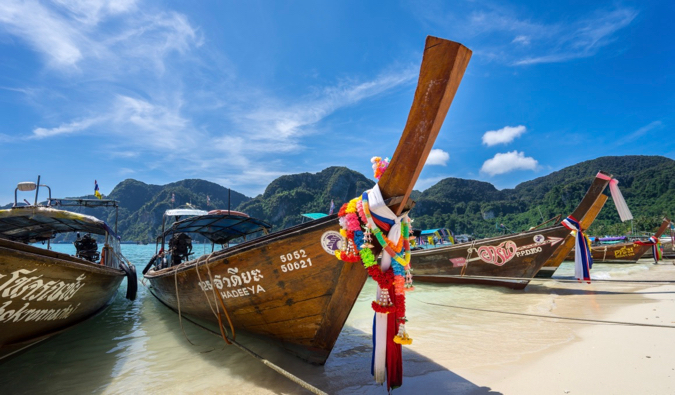
The longtail boats of Koh Phi Phi parked in the sand in front of a bright blue sky in Thailand
Thailand attracts lots of young and new teachers with its cheap cost of living, warm beautiful weather, tropical beaches, mouth-watering food, and party atmosphere.

Most of the language school teachers are ex-travelers looking to save for future travels…or travelers who thought they were doing that but ended up never leaving. The pay in Thailand isn’t that high ($1,000–1,500 USD per month), unless you teach in Bangkok or at an international school.

However, teaching English in Thailand isn’t about making lots of money — it’s about everything else: the ease of getting a job, the food, the fun-loving atmosphere, the weather, and everything in between. It’s one of the best destinations for young, new teachers, especially in a larger city, since you’ll fit right in.

5. China

The massive city of Shanghai, China lit up at night
As China rises in global stature, its need for English teacher grows as more and more citizens need to know the language for their job. Moreover, the culture puts an emphasis on learning it. As such, it is one of the easiest places to find work. No matter where you go, you can find work, even in saturated cities like Beijing and Shanghai.

You can earn a decent salary teaching English here (upward of $1,500-2,000 USD a month), and many jobs give completion bonuses, free housing, and airfare reimbursement.

China is the brave new world and a country in constant change. It’s a good location for teachers of all abilities — there’s something for everyone there!

6. Prague

The many old and medieval buildings of Prague, Czechia
Prague has a seemingly abundant supply of teaching jobs. The city has grown in size over the last few years, attracting a variety of tech start-ups and expats, which has created a lot more job opportunities for teachers.

While it’s very hard to get a job in the public school system or a university, there are plenty of language schools in the city to choose from. The pay isn’t as high as other countries in the world and there are few benefits (especially when compared to Asia or the Middle East), but you’re a stone’s throw away from everywhere in Europe.

The city is one of the most beautiful, vibrant, fun, and popular cities in Europe, which makes Prague an excellent central base from which to explore the continent.

7. Spain

A narrow and winding alley in a traditional area of Cataluna, Spain
Teaching in Spain is one of the best opportunities for anyone looking to work in Europe. There are plenty of jobs, the government has an active program for attracting teachers, and your visa means you can freely travel around Europe.

There are also many opportunities to teach private lessons on the side. You don’t get many benefits (or high pay compared to Asia or the Middle East), but the pay is still enough to live off of.

8. Taiwan

Overlooking the massive city of Taipei, Taiwan on a cloudy day
Taiwan is an excellent country to teach English in, thanks to lots of job opportunities (though they tend to be with young kids), high salaries, benefits similar to South Korea, and lots of other young teachers to share a social life with. The country places a high importance on learning English, and you’ll be able to find freelance tutor opportunities besides your regular, steady teaching job!

I loved my time in Taiwan, made some wonderful friends, and adapted to a completely new culture.

9. Teaching English Online

A man sitting alone on a couch working on his laptop
This was something that didn’t exist when I was teaching. Thanks to the Internet, you no longer have to be tied to one location to teach Teaching online is becoming more popular as a way to make money while working remotely. Platforms like Cambly and italki don’t require any teaching degrees either. The pay isn’t great but it’s something that can have you earn enough money to keep traveling.

***

I had a lot of fun teaching English overseas. It was on my favorite experiences on the road and it taught me so much about myself. You gain a lot of perspective on life by living in another culture.

While there is an opportunity to teach wherever English isn’t the native language, the destinations above draw the biggest crowds, offer the best pay, the best perks, and are the most fun.

If you are thinking about becoming an English teacher overseas, my advice is to head to one of these destinations and just do it!

Ready to Make Money Overseas? Get My Comprehensive Guide

This digital guide will put you ahead of your competition, help you land a high-paying job with a reputable company, and give you first-hand knowledge from real teachers! Get started today with this downloadable PDF (for your computer, e-reader, or mobile device) with the book PLUS 12 interviews about life as a teacher, plus job advice from one of the industry’s top recruiters!

Download eBook


Book Your Trip: Logistical Tips and Tricks

Book Your Flight
Find a cheap flight by using Skyscanner or Momondo. They are my two favorite search engines because they search websites and airlines around the globe so you always know no stone is left unturned.

Book Your Accommodation
You can book your hostel with Hostelworld as they have the largest inventory. If you want to stay somewhere other than a hostel, use Booking.com as they consistently return the cheapest rates for guesthouses and cheap hotels.

Don’t Forget Travel Insurance
Travel insurance will protect you against illness, injury, theft, and cancellations. It’s comprehensive protection in case anything goes wrong. I never go on a trip without it as I’ve had to use it many times in the past. I’ve been using World Nomads for ten years. My favorite companies that offer the best service and value are:

Looking for the best companies to save money with?
Check out my resource page for the best companies to use when you travel! I list all the ones I use to save money when I travel – and that will save you time and money too!

The post The 9 Best Places to Teach English Overseas appeared first on Nomadic Matt's Travel Site.